How a Heavy Duty Dog Harness Is Built: Stitching, Load Paths and Failure Points
A heavy duty dog harness is built at specific stitches in specific places — not by a marketing label. Here is how the category is actually constructed: stitching patterns, load paths, failure points and testing, explained from the factory floor where these harnesses are made.
A heavy duty dog harness is built by routing every load the dog can generate along a designed path of webbing, anchors and stitches — and by reinforcing the specific points where that path historically fails. The label "heavy duty" means nothing by itself; the stitch pattern at the D-ring, the width of the webbing and the dimensioning of the closure mean everything. This article opens up the category from the manufacturing side: how a heavy duty dog harness is built at EASY LOCK, component by component, with the failure points that experience has taught us to design out.
Introduction and Industry Context
The heavy duty segment grew out of a real gap: large, strong and working dogs were being sold harnesses dimensioned like adult clothing is dimensioned — by size label, with the structure assumed to follow. It does not. A harness built for a calm large dog and one built for a powerful dog look similar on a hanger and behave entirely differently at the end of a taut leash. The difference is not one component but a load philosophy: where the force enters, how it travels, and where the structure has been deliberately strengthened because that is where it would otherwise fail.
We speak about this from production experience rather than theory. EASY LOCK was founded in 2018 on more than 15 years of webbing manufacturing for global brands, we weave our own straps, and we build the fifth-generation EASYLOCK magnetic closure system in-house. Heavy duty construction is, for us, the sum of decisions made at the loom, the sewing machine and the test rig — and those decisions are what this article lays out for buyers who need to evaluate the category honestly.
Technical Challenge Breakdown: The Three Load Points in a Heavy Duty Dog Harness
Every force a dog applies to a heavy duty dog harness concentrates at three places, and each has a characteristic failure mode when under-built.
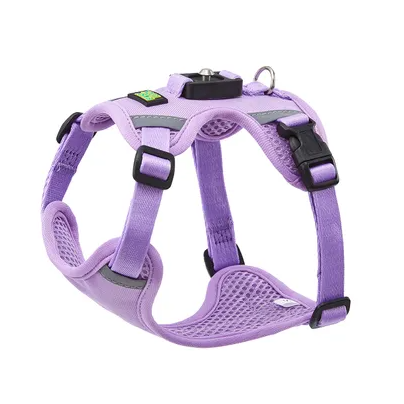
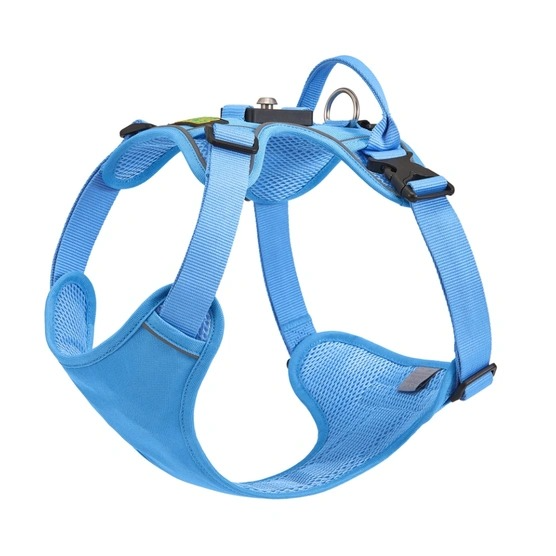
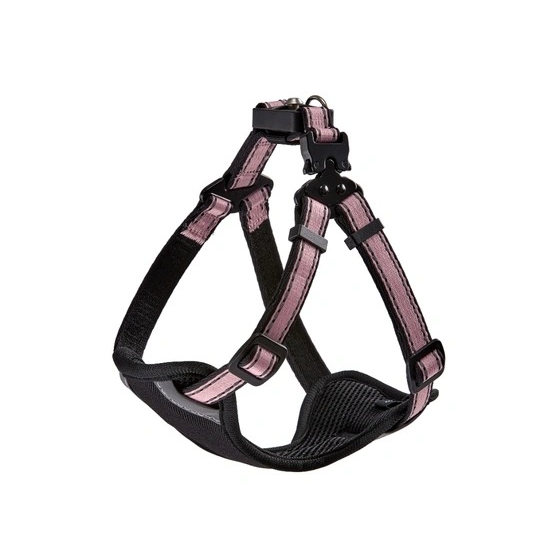
The leash attachment — usually a welded D-ring at the chest or back panel — is where shock load enters the system. Under-built attachments fail by ring deformation or by the stitching anchoring the ring peeling progressively, stitch by stitch, until the ring tears free. The classic sign of an under-spec attachment in the field is a harness that worked fine for months and then "suddenly" failed — in reality, the peel had been advancing invisibly since the first hard pull.
The structural junctions — where chest straps meet girth straps, where webbing passes through sliders and adjusters — are the load path's intersections. Junction failures show as webbing pull-through: the strap slides or tears out of its stitching because the seam was placed at the junction's high-load point instead of offset from it. Junction design is pure pattern engineering, and it is invisible from the outside of a finished harness, which is why it separates factories that engineer from brands that assemble.
The closure is the system's release valve and its last line. A closure that pops open under shock load converts the harness into no harness at the worst possible moment; a closure that cannot be released quickly under stress is its own emergency. Both failure modes are closure-specification failures, and both are testable long before the customer's dog encounters them.
Solution and Engineering Insights: How We Build Each Point
Stitching: Box-and-Cross at Every Anchor
The stitch pattern that dominates serious harness construction is the box-and-cross: a rectangular stitch box around the anchor zone, crossed diagonally corner to corner. The box locks the webbing against sliding; the cross resists the peeling loads that rotate an anchor under an off-angle pull. Heavy bonded thread, matched needle size and controlled stitch density complete the specification. At every load-bearing anchor on our heavy duty line — D-rings, handle mounts, junction overlays — the box-and-cross pattern is standard, sewn with the webbing under proper tension so the seam does its work without puckering the strap it protects.
Load Paths: Continuous Webbing, Not Surface Layers
The design principle underneath the stitching is continuity: leash force must travel through continuous load-bearing webbing from the attachment point into the harness body, not through decorative surface layers with the structural work hidden behind them. On a properly built heavy duty dog harness, turn it over and the architecture is visible — the structural bands run through the junctions, the anchors are sewn through the bands themselves, and nothing load-bearing terminates in fabric alone. Buyers can audit this in thirty seconds with a sample in hand, and it is the single most revealing inspection available in this category.
The Closure: Mechanical Retention, Tested to the System Standard
Our heavy duty configurations carry the same fifth-generation EASYLOCK magnetic system as the full range: a magnetic quick-connect stainless steel closure where magnets handle alignment and a mechanical latch handles retention — pull-tested to 190kg+ with production stitching, and covered by our patented Mag-Clip single-touch release technology detailed on our magnetic buckle technology page. The engineering point for this segment is the retention architecture: magnet strength alone is not a load-bearing strategy for powerful dogs, and any closure design that relies on it should be disqualified for heavy duty use regardless of brand.
The Webbing: Width and Weave From Our Own Looms
The load path's first component is the strap itself, and this is where vertical manufacturing changes the specification conversation. Our heavy duty webbing is woven in-house at widths and weave densities specified per size class — because webbing width is the variable that decides how shock load spreads across the chest and how much redundancy the stitching carries, as we explain in detail in our guide to the large dog harness. Fabric integrity is verified with the same discipline: abrasion on high-rub zones per ASTM D4966 (Martindale), laundering fastness per AATCC 61 / ISO 105, and skin-contact safety to OEKO-TEX Standard 100 expectations on dyed fabric.
Benefits and Expected Output: What Proper Construction Returns
For the end customer, correct heavy duty construction delivers the experience the category promises: the harness holds its fit through the strongest pull, the attachment does not creep or deform, and the one-touch release still works instantly after a season of hard use. For the B2B buyer, the same construction converts into numbers that matter commercially — field failure rates that stay low enough to build a reputation on, return patterns driven by sizing rather than breakage, and a product story grounded in verifiable specifics (190kg+ pull resistance, patented closure technology, in-house webbing) rather than adjectives.
The heavy duty segment rewards suppliers who can prove construction because its customers are the market's best inspectors: owners of powerful dogs inspect their equipment constantly, notice wear early, and talk to each other. A heavy duty dog harness that survives its first season with visible integrity sells the next ten units through owner networks alone — a dynamic our distribution partners in the working-dog segments across 15 countries know well. The current configurations are collected on our heavy duty dog harness page within the broader dog harness collection.
How to Choose: The Buyer's Construction Audit
The audit takes minutes and requires only samples and questions. Inspect the D-ring anchor: box-and-cross stitching through structural webbing, not a surface patch. Trace the load path: continuous bands from attachment through junctions, nothing load-bearing terminating in fabric alone. Check the webbing: width scaling with size class, dense weave, finished edges. Interrogate the closure: mechanical retention behind the magnet, a stated pull-test figure with production stitching (ours: 190kg+), and an instant release. Ask for fabric test data: abrasion and laundering methods by name. A supplier who answers every point with specifics has built the harness; one who answers with "premium quality materials" has bought it.
Materials Under the Stitches: What the Load Path Is Made Of
Stitching patterns and load paths assume the material between them is honest, so the material bill completes the heavy duty specification. The webbing on our heavy duty line is woven in-house at widths and densities specified per size class — the variable we discussed in detail in our guide to the large dog harness, because width is what spreads shock load before the stitches ever see it. Thread is heavy bonded polyester, selected for strength retention when wet, since a working dog's harness lives a wet life more often than a dry one. Hardware is specified rather than assumed: welded D-rings, sliders that lock without creep, and contact components in stainless steel.
Each material choice is verifiable the same way the stitching is: by asking for its evidence. Laundering fastness on the fabric per AATCC 61 / ISO 105 methods, abrasion on high-rub zones per ASTM D4966 (Martindale), skin-contact expectations per OEKO-TEX Standard 100 on dyed fabric, and the closure assembly's pull figure — 190kg+ with production stitching on our lines. A heavy duty dog harness is a chain of verified components, and the buyer who asks for the chain by name ends up with a product that survives its segment's most demanding customers.
Frequently Asked Questions
Q1: What pull strength should a heavy duty harness have?
Look for a stated figure tested with production stitching, not hand-made samples — on our heavy duty line the closure assembly is verified to 190kg+. The figure matters less than the testing discipline behind it: per production lot, with failure-mode logging, not a one-time design certificate.
Q2: Are magnetic closures strong enough for heavy duty use?
Ours are, because the magnets handle alignment while a stainless steel mechanical latch handles retention — the design distinction that separates engineered magnetic closures from magnet-in-a-shell products. Any magnetic closure for powerful dogs should be evaluated on its retention mechanism and pull-test data.
Q3: What fails first on a cheap heavy duty harness?
In field experience: the D-ring anchor stitching peels first, then under-width webbing shows edge wear, then under-spec sliders slip and the fit degrades. All three are construction-specification failures visible in a pre-purchase sample audit.
Q4: Can you build a heavy duty line under our brand?
Yes — OEM and ODM heavy duty programs are core factory business: custom webbing widths and colors, size curves, closure configurations and branding, all produced in-house from loom to closure. Contact the factory with your segment's requirements.
Final Thoughts
A heavy duty dog harness is built at three load points — attachment, junctions and closure — with box-and-cross stitching, continuous load paths and a mechanically retained closure, all dimensioned for the dog's worst moment rather than its size label. The failure points are known, predictable and designable-out; the only question is whether the supplier did the engineering or skipped it.
EASY LOCK builds the heavy duty dog harness line from its own looms and its own patented closure system — 190kg+ pull-tested, environmentally verified, and proven with customers in 15 countries since 2018. Audit any sample against the checklist in this article, including ours; the construction is meant to be seen.
Inspect the Construction, Not the Label
Order heavy duty samples with full construction documentation — stitching patterns, load path and closure test data — direct from the factory.
Request Construction Samples