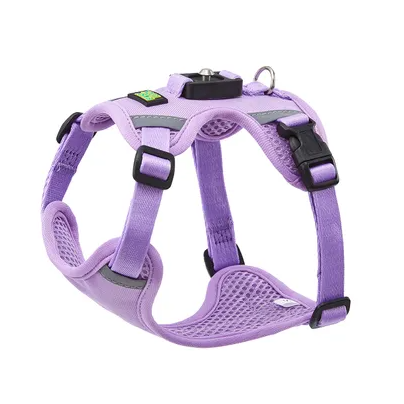
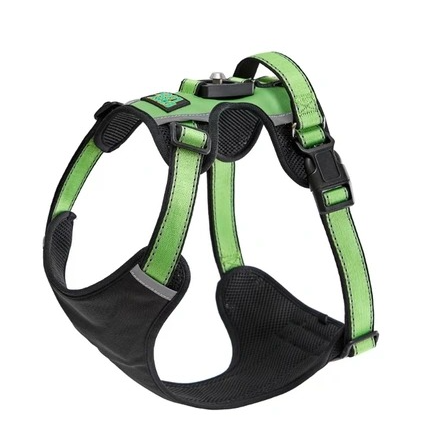
How to Source a Reflective Dog Harness That Survives Repeated Washing
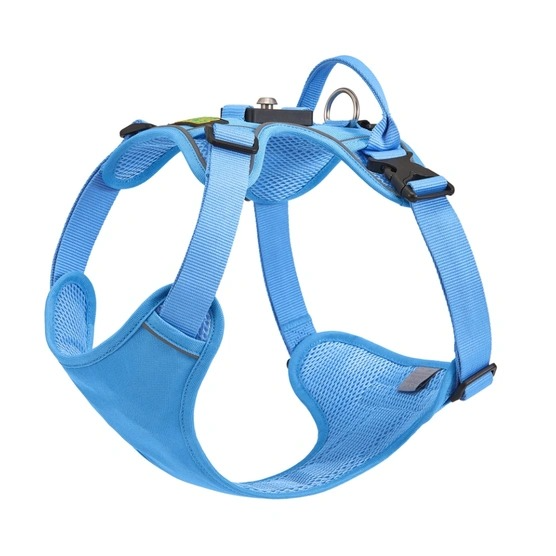
A reflective dog harness that survives repeated washing is bought with construction and test data, not brightness claims. Most are brightest on the day they ship; here is how to source one that still performs after fifty laundry cycles — stitched versus glued construction, laundering evidence and the exact questions to put to any supplier.
To source a reflective dog harness that survives repeated washing, buy construction and test data rather than brightness claims: specify stitched-in retroreflective material over glued film, demand wash-decay evidence per cycle count, and verify the base fabric's colorfastness on recognized textile methods. We weave our own webbing at EASY LOCK, including reflective configurations, and this guide explains how to source a reflective dog harness that still performs after fifty laundry cycles — not one that photographs well on the product page and fades by month three.
Why Reflective Performance Is a Sourcing Problem, Not a Feature Choice
Every harness catalog shows reflective accents. Almost none of them tell you what happens to those accents after the harness has been washed the way real households wash things — tossed in with the load, warm water, regular detergent, sometimes tumble-dried against advice. Yet washing is precisely where reflective performance is won or lost, because the retroreflective effect depends on a precision structure: thousands of tiny optical elements (glass beads or microprisms) that return light toward its source. That structure is fragile at its boundaries, and every wash cycle attacks the boundaries first.
For B2B buyers, this creates a familiar trap. The reflective dog harness you sample looks identical from two suppliers; the one that costs less is cheaper because its reflective trim is a glued film with fewer beads per square centimeter and a weaker binder. Both pass a first impression. Only one survives the customer's washing machine, and the difference will arrive back at your counter as a complaint about a harness that "stopped being reflective" — a return the product page never warned you about. Asking about wash survival up front is the cheapest quality control available in this category.
Construction First: Stitched-In Trim Beats Glued Film
The single biggest construction decision is how the reflective material attaches to the harness. Glued or heat-transferred film sits on the surface of the webbing as a layer — and any layer glued to a flexible strap lives in constant shear stress as the strap bends, flexes and abrades. Washing accelerates the failure: water penetrates the film edges, detergent works the bond, and flex cycling peels the film from the edges inward. The visual signature of a failed glued trim is unmistakable — corners lifting, then strips flaking, then a dull gray residue where the optical layer used to be.
Stitched-in reflective material — where the retroreflective yarn or trim is woven into the webbing itself or sewn through as a band — removes the delamination failure mode entirely. There is no glue layer to attack; the optical elements are held mechanically, protected within the weave. This is the construction we use across our reflective configurations: the reflective strips in the reflective dog harness line are stitched into the webbing we manufacture ourselves, not applied to it. When you audit a sample, this distinction takes thirty seconds to verify — look at the edges of the reflective band and check whether the material is integrated into the strap or sitting on top of it.
Testing Second: What Evidence to Demand From Any Supplier
Construction predicts survival; testing proves it. The evidence package for a wash-survivable reflective harness has three parts, and all three are reasonable to request in a first sourcing conversation.
First, wash-decay behavior on the reflective element: how the retroreflective performance holds across a stated number of laundering cycles, using a recognized method rather than an in-house "we washed it" claim. The textile industry's colorfastness-to-washing frameworks — AATCC 61 and the ISO 105 series — are the methods we work to on our webbing, and the same laundering discipline applies to the reflective configurations. Second, colorfastness on the base fabric: a reflective harness whose base color bleeds or fades after five washes undermines the whole product's perceived quality, and the test methods are the same. Third, construction integrity after laundering: stitched reflective bands should hold their stitching through the cycle count, and the webbing's edge finish should not fray — verifiable on washed samples, which any serious factory will provide.
Supplier Questions That Filter Fast
- Is the reflective material stitched or woven in — or glued on top?
- What laundering method and cycle count is the reflective performance verified to?
- Can you supply washed samples — e.g. after 20 and 50 cycles — not just new ones?
- What colorfastness methods (AATCC 61 / ISO 105) apply to the base fabric?
- Do you weave the webbing yourself, or buy it finished?
- What skin-contact standards apply to the dyed fabric (e.g. OEKO-TEX Standard 100 expectations)?
Why the Factory Behind the Webbing Matters Here
Reflective durability is decided upstream of the sewing floor — at the loom. How the reflective yarn is integrated into the weave, how many retroreflective elements per centimeter the band carries, how the edge finish protects the boundary: these are weaving decisions, and a brand that buys finished webbing on the open market inherits them as fixed constraints. EASY LOCK weaves its own webbing — the brand was founded in 2018 on more than 15 years of webbing manufacturing experience, and today supplies customers in 15 countries — which means the reflective band specification is ours to set and ours to verify, cycle after cycle.
Vertical control also keeps the reflective harness honest at the system level. A reflective strap that fades but stays intact is a quality issue; a closure that corrodes is a safety issue, and it lives in the same product. Our fifth-generation EASYLOCK magnetic quick-connect stainless steel closure — pull-tested to 190kg+, covered by the patented Mag-Clip single-touch release described on our magnetic buckle technology page — was developed through three years and 100+ rounds of material testing, precisely so that one component's specification never undermines another's. When you source the whole harness from the factory that makes its own materials, the wash-survival question has one answer instead of three.
How to Choose the Right Reflective Dog Harness for Your Range
Match the reflective specification to the use case your market actually has. Urban dog owners walk at dawn and dusk against traffic — visibility is a core function, and the reflective banding should be generous, positioned on the sides and chest where headlight angles actually strike. Rural and trail users need visibility mostly at the road crossing and the parking lot, and weight more reflectivity per square centimeter than total area. In both cases, the deciding variable is the same: does it survive the washing machine, because a dirty harness gets washed and a reflective harness that dies in the wash stops being a reflective harness.
For assortment builders, we recommend positioning reflective configurations as the safety-led line within the main dog harness collection, with the wash-survival evidence as the shelf story — retailers who show a 50-cycle washed sample next to a new one close the sale without a single marketing adjective. And because the reflective line shares the fifth-generation magnetic closure with the rest of the range, it inherits the one-touch fitting experience that drives repeat purchases in every segment we serve, from the Vitality Collection harness to the full product catalog.
The Two Survival Enemies: Water Ingress and Edge Abrasion
Understanding why glued film fails helps buyers spot the risk in any sample, so it is worth naming the two mechanisms precisely. Water ingress is the quieter one: washing water penetrates the boundary between film and webbing, and the wet bond — even a good one — loses cohesion cycle by cycle until the first corner lifts. Edge abrasion is the visible one: a flexible strap bends thousands of times per walk, and the film's edges, being rigid relative to the strap, work against the weave until they crack and peel backward from the corners.
Stitched-in or woven-in reflective material defeats both mechanisms for the same reason: there is no boundary layer to infiltrate and no rigid edge to abrade. The optical elements live inside the textile structure, protected by the same yarns that carry the strap's load. This is not a premium affectation — it is the standard the safety-vest and workwear industries settled on decades ago for exactly the same laundering reasons, and the pet trade arrived at it later only because pet harnesses were historically specified down to a price. Buyers who specify "no surface-applied retroreflective film" in one line of their RFQ eliminate the entire failure class before sampling even starts.
Frequently Asked Questions
Q1: How many washes can a quality reflective harness survive?
A stitched-in reflective band on properly specified webbing is engineered for the product's whole service life of laundering — the meaningful question is which cycle count the supplier verifies performance to, and whether they will show you washed samples. Glued-film trims typically show edge lift within the first handful of cycles.
Q2: Does washing really reduce reflectivity that much?
For surface-applied film, yes — water penetration, detergent and flex cycling attack the bond from the edges. For material integrated into the weave, the optical elements are mechanically protected and the decay across the verified cycle count is the relevant, testable figure. Construction choice dominates the outcome.
Q3: Are reflective strips enough for night walking safety?
Reflective material returns light to its source, so it works when a light source — headlights, a flashlight — strikes it, and it is a core component of night visibility. We recommend it as standard equipment on every harness; how customers complement it on unlit routes is their choice, but the harness itself should carry honest, wash-durable retroreflection.
Q4: Can you produce a custom reflective configuration for our brand?
Yes. As the weaving factory we control band width, placement, base colors and the closure system, with wash-cycle verification included in OEM sampling. Send your market's use profile and we will propose the reflective specification to match.
Final Thoughts
Sourcing a reflective dog harness that survives repeated washing comes down to three decisions: construction (stitched-in over glued), evidence (recognized laundering methods and washed samples, not brightness claims) and provenance (a factory that weaves its own webbing controls the variables that matter). Suppliers who volunteer this information are telling you how they build; suppliers who deflect are telling you too.
The EASY LOCK reflective dog harness line is built on in-house woven, stitched-in reflective webbing with laundering verification to AATCC 61 / ISO 105 methods, paired with our fifth-generation magnetic closure. Review it on the EASY LOCK reflective dog harness page — and ask us for the washed samples. We keep them on hand.
See Washed Samples, Not Just New Ones
Request our reflective harness sampling set — including laundered test samples — and verify wash survival before you commit to a volume order.
Request Washed Samples