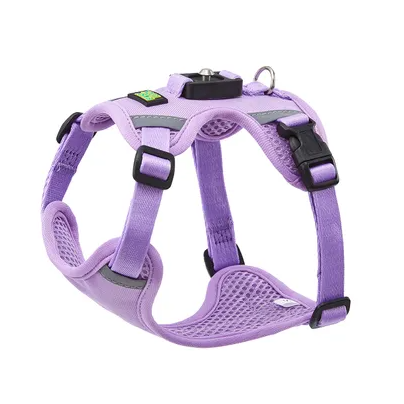
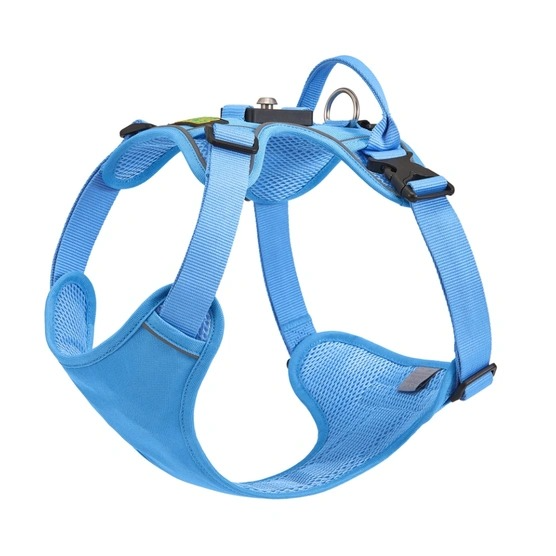
How We Test a Quick Release Dog Harness Before It Ships
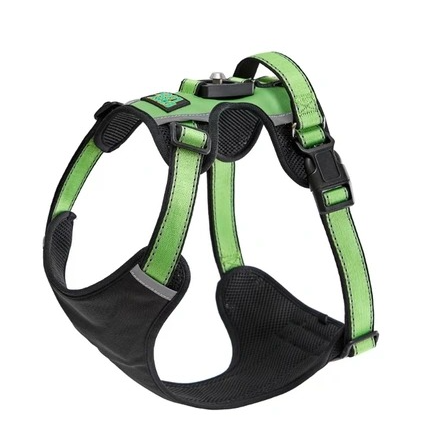
A quick release dog harness earns its shipment only after the closure has passed our full pre-shipment protocol — pull tests, cycle tests, environmental exposure and the failure criteria we apply — written by the factory, for B2B buyers who want to audit what they are paying for.
Before any quick release dog harness leaves our factory, its closure and webbing pass through a fixed sequence of pull, cycle and environmental tests — because a quick release mechanism has to do two opposite things perfectly: hold under sudden load and open instantly on command. We have been manufacturing quick release dog harness hardware since EASY LOCK was founded in 2018, on top of more than 15 years of webbing experience, and this article walks you through exactly how we test a quick release dog harness before it ships, in the order we test it, with the pass/fail logic our QC team applies.
Why Quick Release Testing Is a B2B Buying Issue
From the outside, a quick release buckle is a lump of plastic or metal. From inside the industry, it is the component with the highest consequence of failure. When a quick release harness is working, nobody notices it. When one fails — a buckle that pops open when a dog lunges, or one that jams shut when the owner needs it off in an emergency — the consequences land on your brand, not on the factory that cut the corner. That is why we encourage every OEM and wholesale customer to ask suppliers not just "do you test?" but "test what, how, and what happens when a sample fails?"
The quick release dog harness category splits into two engineering problems. The first is retention: the closure must resist the loads a dog generates at the end of a leash, including the shock loads of a lunge. The second is release reliability: the mechanism must open with one hand, under no load, thousands of times over the product's life, without loosening, jamming or wearing out. A closure that does only one of the two well is not a quick release harness; it is either a hazard or an inconvenience. Our test protocol measures both, deliberately.
Stage 1: Static Pull Testing on the Closure
The first test is the simplest and the most unforgiving. We mount a closed closure assembly — both harness halves, webbing sewn in as production stitches them — into a pull-test rig and apply a steadily increasing tensile load until something gives. For the magnetic quick-connect stainless steel closures used across our harness line, the acceptance threshold is 190kg+: the assembly must sustain that load without separation, webbing slippage or housing fracture. That figure is not arbitrary. It reflects the upper range of shock loads a large, determined dog can transmit through the chest attachment during a lunge, with a safety margin above it.
What are we looking for in the failure mode, when a sample fails? Not just "it broke," but where and how. A webbing that pulls out of its stitch pattern points to a sewing specification problem. A housing that cracks points to an injection molding or material problem. A latch that shears points to a mechanism geometry problem. Each failure mode routes to a different corrective action on the floor, and that diagnosis loop is what a buyer should expect from a factory that treats testing as engineering rather than ceremony.
Stage 2: Cycle Testing the Release Mechanism
Retention is half the story. The other half is whether the release keeps working after a year of daily use. In cycle testing, we actuate the quick release mechanism repeatedly — close, release, close, release — on an automated rig, and we sample the actuation force at intervals. A healthy quick release dog harness closure should open with a consistent, moderate thumb force for thousands of cycles. When the force starts creeping upward, that is the early signature of wear debris, spring fatigue or latch geometry degradation, and the sample fails before the mechanism actually jams, because by then it is already failing the user.
Cycle testing also catches a subtle defect that static pull testing cannot: intermittent false release. If a latch begins to seat inconsistently after a few thousand cycles, the closure may pop open at lower-than-rated load. Our QC standard treats any mid-cycle-test separation under normal handling as an immediate fail, regardless of how the static numbers looked. For buyers, this is the single most valuable test to ask about, because it is the one that cheapest suppliers skip.
Testing Checklist for Buyers
- Static pull: closure holds rated load with production stitching, not hand-made test samples
- Cycle test: release force measured at intervals, not just "it still opens"
- Environmental: salt spray and wash exposure before final pull re-test
- Webbing: abrasion and colorfastness data, not just fabric hand-feel
- Failure mode review: the factory can tell you how samples fail, not only whether they pass
Stage 3: Environmental Exposure
Harnesses live outdoors. They get rained on, dragged through sand, dropped in seawater and licked by dogs whose saliva is mildly corrosive to the wrong metals. So before a production lot is approved, samples go through environmental exposure that simulates those realities. For metal components — including the magnetic stainless steel quick-connect closures — we use salt spray testing per ASTM B117, the same methodology the fastener industry uses to qualify corrosion resistance. Components come out of the chamber and go straight back to pull and release testing, because a closure that corrodes stiff is a closure that will jam when it matters.
Fabric gets its own battery. The webbing we weave in-house — backed by our 15-plus years of webbing manufacturing — is tested for colorfastness to washing per AATCC 61 and ISO 105 methods, so a harness that looked great on arrival still looks great after repeated laundering. High-rub zones are evaluated for abrasion resistance per ASTM D4966 (Martindale), because chest panels and adjustment points see constant micro-movement against the dog's coat. And for anything that touches skin, including dyed webbing, we work to OEKO-TEX Standard 100 expectations on the fabric side, which matters increasingly for retail partners facing REACH SVHC and Prop 65 questions in the EU and US.
Stage 4: Assembly and Line Audit
Testing validates the design; line audits validate the production run. Before shipment, we audit the sewing specification on sampled units — stitch density, pattern integrity at load-bearing junctions, box-and-cross stitching at D-rings — and we check that every unit's quick release mechanism actuates cleanly by hand. On the magnetic closure lines, each closure is function-checked so that no unit ships with a slug mechanism. This stage is unglamorous, but it is where the tested design either survives contact with volume production or does not.
A detail worth mentioning for OEM customers: because we weave our own webbing and control the closure supply chain, the units we test are built from the same material lots that ship. Factories that buy closures and webbing on the open market can pass a test on "golden samples" and then ship something different. Vertical control closes that gap, and it is one of the structural reasons our quick release dog harness line holds its quality curve across reorders.
One output of this stage deserves a mention because buyers rarely see it: the test record itself. Every production lot that passes generates documentation — pull values, cycle counts, environmental exposure results and the material lots used — archived against the order number. When your customer asks, months later, what standard a given batch was built to, the answer exists on paper rather than in memory. For OEM customers this record becomes part of the shipment file; for wholesale buyers it is quiet insurance. We recommend asking any supplier — including us — how long test records are kept and whether they can be attached to your orders. A factory that can produce last year's numbers within the hour is a factory whose numbers were real.
What We Do When a Sample Fails
A testing protocol is only as credible as its failure handling. When a sample fails any stage, the lot does not ship. The failure mode is logged, root-caused and routed: webbing slippage goes back to sewing parameters, housing cracks go back to molding, release-force creep goes back to the mechanism supplier or, in our case, to our own closure line. Corrective actions are verified with re-tests before the production lot is re-approved. In the years since the fifth-generation EASYLOCK magnetic system went through its development cycle — three years of engineering and more than 100 rounds of material testing — this loop has become routine, which is exactly what you want: a factory where failure handling is process, not drama.
Choosing a Quick Release Dog Harness Supplier: Questions That Filter Fast
If you are evaluating suppliers for a quick release dog harness program, the fastest filter is a short list of questions. Ask what load the closure is pull-tested to and whether the test used production stitching. Ask how many release cycles the mechanism is qualified for and how actuation force is tracked. Ask which environmental tests are run — salt spray per ASTM B117 is a good discriminator — and whether fabric carries colorfastness data per AATCC 61 / ISO 105. Ask who weaves the webbing. And ask to see a failure-mode log, not a certificate. A factory that answers all five in one email is a factory with a real QC culture; a factory that answers with marketing adjectives is not.
For reference, our quick release configurations span the full harness range — from the lightweight designs in the light harness collection to the heavy-duty chest panels in the main dog harness line — with the same testing protocol applied across sizes XS through XL. The closure hardware is common across the range, which simplifies your SKU logic and keeps replacement-part logistics clean for your service team.
Frequently Asked Questions
Q1: What load is the quick release closure tested to?
Our magnetic quick-connect stainless steel closures are pull-tested to 190kg+ with production stitching, covering the shock-load range of large dogs with margin. The test is repeated on every production lot, not just the design qualification.
Q2: Can the release open accidentally when the dog pulls?
No — that is what cycle testing and the release-force window are designed to prevent. The release button sits recessed on the housing face and requires deliberate thumb pressure; the mechanical latch, not magnet force alone, holds the closure under load.
Q3: Do you test the fabric as well as the buckle?
Yes. Colorfastness per AATCC 61 / ISO 105, abrasion per ASTM D4966 Martindale, and OEKO-TEX Standard 100 expectations on dyed, skin-contact fabric. Fabric and closure are tested as an assembly before shipment.
Q4: Can buyers witness or review the tests?
OEM customers can request test records with their orders, and third-party inspection is welcome at our facility. We would rather have a customer see the process than take our word for it — that has been our position since we started exporting in 2018 and now serve customers in 15 countries.
Final Thoughts
A quick release dog harness earns its name in two moments: the lunge it survives and the emergency it opens in. Everything we test — static pull, cycle life, salt spray, wash fastness, line audits — exists to make sure both moments end well. Buyers who test their suppliers with the same discipline they expect from the product consistently end up with fewer returns, fewer after-sales disputes and better shelf reputation.
If you are building or refreshing a quick release harness program, put the testing questions above in your first email to any supplier, including us. Then compare the answers side by side. You can review the current quick release configurations on the EASY LOCK quick release dog harness page or browse the full product range — and if you want the protocol applied to your own OEM specification, our engineering team is one message away.
See the Test Data Behind the Closure
Request the full pre-shipment testing protocol and closure specifications for your target sizes — straight from the factory floor, no trading desk in between.
Request the Test Protocol