How to Stop a Small Dog Harness From Riding Up on Toy Breeds
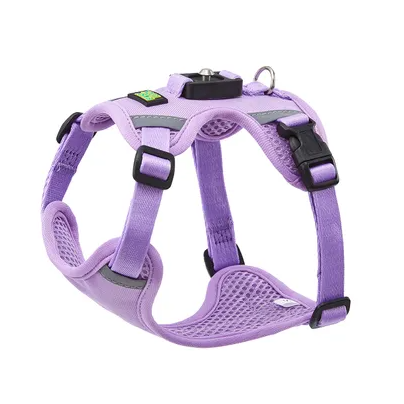
A small dog harness rides up on toy breeds when its geometry is scaled from larger patterns instead of engineered for small bodies — and it stays put when chest-strap position, adjustment stability and closure balance are designed for the size class. On a Chihuahua, a shift of two centimeters is ten percent of the fit; here is the factory-side guide to stopping the ride-up.
A small dog harness rides up on toy breeds when its strap geometry, width ratios and adjustment behavior are scaled from larger designs instead of engineered for small bodies — and it stops riding up when the chest strap sits low and wide relative to the girth, the adjustment holds without creeping, and the closure adds no forward-pulling imbalance. Fitting technique matters, but construction decides the ceiling of what fitting can achieve. As a manufacturer that produces the full XS curve, this article explains how to stop a small dog harness from riding up on toy breeds: the physics of the shift, the construction variables that control it, the fitting sequence that gets the most from a well-built harness, and what B2B buyers should specify for the segment.
Understanding the Necessity: Why Toy Breeds Suffer Riding Up Most
Riding up is the migration of the harness's chest strap upward and backward during wear — from the sternum where it belongs into the armpits, and on bad fits into the throat. Toy breeds experience it worst for reasons of geometry, not temperament. Their legs are short relative to their body depth, so the front-leg swing sweeps through the chest strap's working zone at a steeper angle; their stride frequency is high, multiplying the number of micro-collisions per walk; and their chest depth-to-width ratio differs enough from medium dogs that a strap proportioned "proportionally" from a larger pattern lands in the wrong place on the real body. Every one of those factors converts into small displacements — and on a body measured in centimeters, small displacements are large percentages.
The consequences compound. A strap that has ridden into the armpit chafes with every stride — and thin toy-breed skin is the most chafe-sensitive in the entire size range, which is why our small-size webbing carries the same ultra-soft, anti-chafe woven finish as the senior-focused lines rather than a downgraded fabric. A harness migrating toward the throat transfers pressure toward the neck and trachea — the exact structure a harness exists to protect, and one where toy breeds carry known vulnerabilities. And a harness that shifts is a harness the owner readjusts constantly, then eventually abandons: fit-fatigue returns are disproportionately concentrated in the small sizes across our distribution partners' books. That is the necessity behind engineering this problem out rather than fitting around it.
The Construction Variables That Decide Whether a Harness Stays Put
Chest Strap Position and Width Ratio
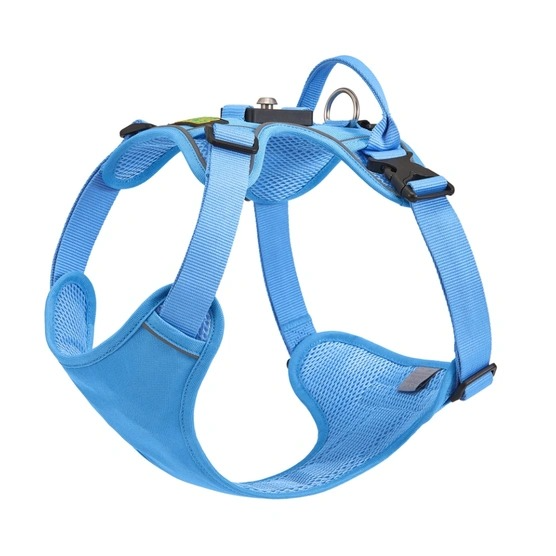
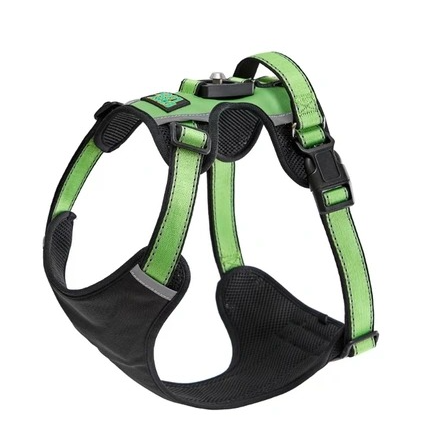
The first variable is where the chest strap sits in the harness's neutral geometry — before any fitting. On a correctly engineered small dog harness, the chest strap's designed position is low and forward: over the sternum, behind the front legs with clear clearance for the leg swing. Designs that place the chest panel high — common when a larger pattern is shrunk — start the harness one error away from the armpit before the dog takes a step. The width ratio matters alongside position: a chest strap proportionally narrower than the girth straps creates a stiffness gradient that encourages the narrow strap to roll and migrate. Our small-size configurations set the chest strap at full width parity with the girth system, which is a deliberate cost-of-materials choice that many value-tier products skip.
Adjustment Behavior: Creep Is Riding Up in Slow Motion
The second variable is whether the fit holds. A slider that creeps under cyclic load does not need a dramatic failure to ruin a toy-breed fit — two millimeters of creep per walk repositions the chest strap within days, and the owner experiences it as "the harness keeps loosening." On small sizes this is amplified because strap lengths are short: the same absolute creep crosses a larger fraction of the adjustment range. Our adjustable buckles are specified and tested to hold their setting under load without slipping — the same lock-and-hold discipline we apply across the adjustable dog harness range — and small-size sliders are dimensioned so they sit mid-range, with engagement, rather than at the strap's end where holding is weakest.
Closure Weight and Balance
The third variable is the closure. On a two-kilogram dog, every gram of hardware is proportionally significant, and a closure concentrated on the chest panel can tilt the harness's balance toward riding behaviors. This is where closure engineering for small sizes earns its keep: our fifth-generation EASYLOCK magnetic system — the stainless steel quick-connect mechanism protected by our patented Mag-Clip single-touch release, described on our magnetic buckle technology page — is produced in configurations dimensioned for the small classes, so the closure delivers one-touch operation without dominating the harness's weight distribution. Buyers should ask specifically how closure hardware is scaled across size classes; "the same buckle on every size" is a manufacturing convenience, not a design answer.
The Fitting Sequence: Getting Everything a Good Harness Offers
Construction sets the ceiling; fitting reaches it. On a well-engineered harness, the anti-ride fitting sequence for toy breeds is short and repeatable. Fit the chest strap low first — over the sternum, a finger's clearance behind the front legs — before any other adjustment, because chest-strap height is the master variable. Set the neck opening snug next: excess neck adjustment is the allowance that lets the whole harness rotate upward, so take it up until the neck gap is two fingers, no more. Then balance the girth to hold the geometry without compressing a small ribcage, finishing with the two-finger check under every strap. Walk ten steps and recheck once: a correctly built and correctly fitted harness passes that recheck unchanged, and keeps passing it for the life of the walk — that single observation separates the product's construction quality faster than any spec sheet.
Anti-Ride Checklist — Construction Side (What Buyers Should Audit)
- Chest strap designed low and forward over the sternum, not scaled from a large pattern
- Chest strap width at parity with girth straps — no stiffness gradient
- Lock-and-hold adjustment sliders, tested for creep under cyclic load
- Closure hardware dimensioned per size class, not one buckle for all sizes
- Ultra-soft, anti-chafe webbing — small sizes are the most chafe-sensitive
- Ten-step recheck: geometry unchanged after a short walk
How to Choose the Right Small Dog Harness for Your Range
The toy-breed segment is the highest-velocity segment in most of our partners' assortments — small dogs dominate urban markets, and their owners buy more frequently across a lifetime that runs longer than larger breeds'. It is also the segment where construction shortcuts are most visible to the customer, because there is less body to hide them on. The specification priority list we recommend: fit geometry first (low, wide chest strap designed for small proportions), adjustment stability second, soft contact third, and one-touch closure throughout — because toy-breed owners include a high share of senior owners and apartment dwellers who value the fast fitting as much as the fit itself. The one-touch magnetic closure across our small sizes also means the harness never needs a two-handed struggle on a dog that weighs less than the harness packaging.
For buyers building the segment, stock the small curve as its own program rather than the bottom of a general size run: dedicated XS and S configurations with the anti-ride construction variables specified above, matched colorways with the rest of the range, and the same closure platform. EASY LOCK — founded in 2018 on more than 15 years of webbing manufacturing, now supplying customers in 15 countries — produces the small dog harness line to exactly that brief, with fabric laundering fastness verified to AATCC 61 / ISO 105 methods and closures pull-tested to 190kg+ with production stitching. The current configurations are on our small dog harness page within the full product catalog.
Frequently Asked Questions
Q1: Is riding up always a fitting mistake?
No — fitting can only position what the construction supports. A harness whose chest strap is designed high, whose sliders creep, or whose closure unbalances a tiny body will ride up no matter how carefully it is fitted. Audit the construction variables first; then the fitting sequence delivers what they promise.
Q2: How tight should a toy-breed harness be?
Two fingers flat under any strap, with the neck opening taken up snug — excess neck allowance is what lets the harness rotate upward. On small sizes, check the fit weekly: short strap lengths mean small changes matter more, and creeping sliders show up faster.
Q3: Does a one-touch magnetic closure work on very small harnesses?
Yes — the fifth-generation system is produced in small-size configurations with hardware dimensioned for the class, so the one-touch operation comes without weight or balance penalties. Retention remains mechanical and pull-tested, not dependent on magnet force alone.
Q4: Can we get an anti-ride XS program under our brand?
Yes — small-size fit geometry, slider specification and closure scaling are all set at our factory level, with OEM colorways and packaging on top. Contact EASY LOCK with your market's breed-size profile to scope the program.
Final Thoughts
A small dog harness rides up on toy breeds when its geometry, sliders and closure are scaled from larger patterns instead of engineered for small bodies — and it stays put when the chest strap is designed low and wide, the adjustment locks without creep, and the closure respects the size class's balance. Fix those construction variables and the fitting sequence becomes short, reliable and permanent; ignore them and no amount of readjusting will hold the fit.
The anti-ride small dog harness range — one-touch magnetic closures scaled per size class, lock-and-hold adjustment, ultra-soft webbing across the XS curve — is on the EASY LOCK small dog harness page for B2B buyers.
See the Ten-Step Test Pass on Camera
Request small-size samples and run the walk-and-recheck test yourself — factory-direct, with the full anti-ride construction specification documented.
Order Small-Size Samples