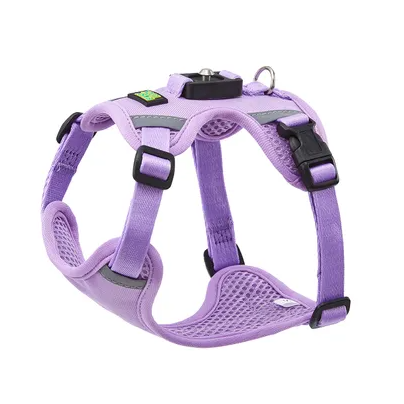
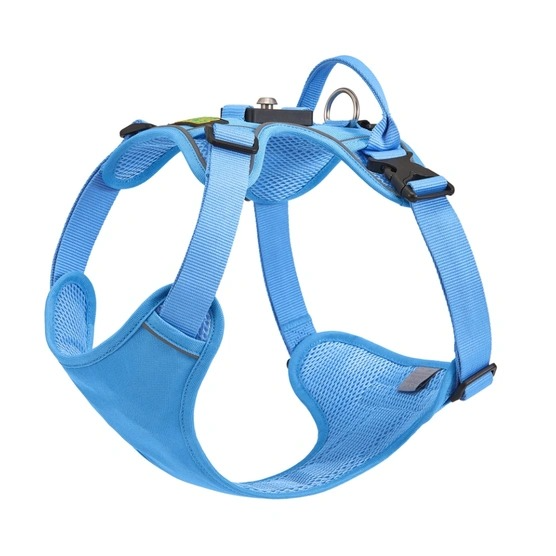
How to Fit an Adjustable Dog Harness on Deep-Chested and Barrel-Chested Breeds
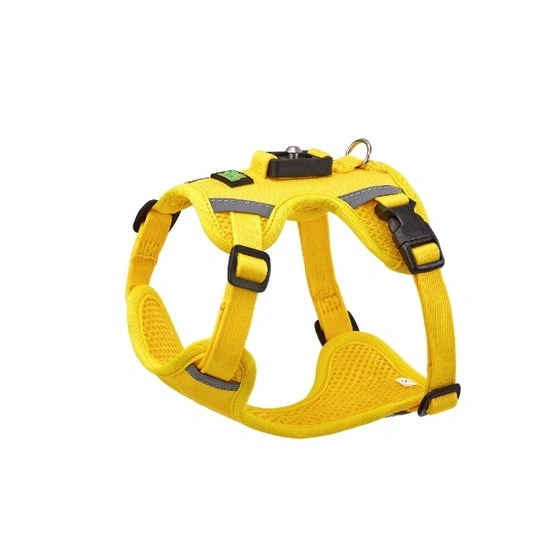
An adjustable dog harness must be fitted to chest geometry, not weight — a Greyhound and a Bulldog can share a size label yet need opposite adjustment strategies. Here is how to fit one on deep-chested and barrel-chested breeds, from a factory that builds the adjustment hardware and sees the fit failures that bad sizing causes.
Fitting an adjustable dog harness on deep-chested and barrel-chested breeds comes down to one principle: adjust the harness to the dog's chest geometry, not to the dog's weight. A deep-chested Saluki or Doberman and a barrel-chested Bulldog or Pug can both fall into the same size class on a weight chart, yet their ribcages demand opposite adjustment strategies. We manufacture the adjustable buckles and webbing that make those strategies possible, and this guide explains how to fit an adjustable dog harness correctly on both body types — and what buyers should check to make sure their supplier's harness can actually deliver the fit range it claims.
Understanding the Necessity of an Adjustable Dog Harness
The pet industry sells harnesses by size charts, but dogs do not come in charts. Within any single size class there is an enormous spread of chest depth, chest circumference and shoulder width. A fixed-size harness that fits the "average" dog in the middle of the class fails at both edges — and the edges are where the returns come from. In our OEM business, fit-related complaints consistently outnumber fabric and hardware complaints combined, and nearly all of them trace back to insufficient adjustment range rather than to the wrong size being shipped.
An adjustable dog harness solves this at the design level by putting independent adjustment points on the chest strap and the neck opening (and on many designs, the girth as well). Each point moves the load-bearing geometry to match the individual dog. For B2B buyers, that adjustability is not a comfort feature — it is an inventory feature. The wider and more stable the adjustment range, the fewer SKUs you need to cover a market, and the lower your exchange rate when customers guess their dog's size wrong.
This is why we treat the adjustable buckle as a core component rather than an accessory. Our harnesses use adjustable buckles engineered to hold their setting under load without slipping — a failure mode we test deliberately, because a harness that slowly loosens itself over a walk changes its own fit and load distribution, which is exactly what adjustment was supposed to prevent. You can see the current adjustment configurations across our adjustable dog harness range.
Fitting Deep-Chested Breeds: Height Before Girth
Deep-chested breeds — sighthounds, Dobermans, Great Danes, Weimaraners, Standard Poodles — carry a ribcage that is tall and narrow relative to its circumference. The classic failure on these dogs is a harness that slides up the chest toward the throat, because the strap geometry was set for a rounder chest. The correction sequence we recommend is simple and repeatable.
First, set the chest strap low before you touch anything else. On a deep chest, the strap should sit at the widest point of the ribcage, well behind the front legs — roughly a hand's width behind the elbow. If you start by tightening for snugness, you will end up with a harness that is snug at the wrong height and rides up with the first gallop. Second, shorten the neck opening as much as the dog's build allows. Deep-chested dogs usually need a relatively smaller neck opening relative to girth than weight charts suggest; excess neck adjustment is the single biggest cause of throat-pressure complaints on these breeds. Third, only then take up the remaining slack on the girth side, finishing with the two-finger rule: two fingers should slide flat under any strap, but no fist.
One structural note matters here: on deep chests, the adjustment hardware spends its life at the extreme ends of the webbing. A slider that is barely engaged holds poorly. When we spec an adjustable dog harness for markets where sighthounds are common, we extend the webbing allowance so the sliders always sit mid-range — a small manufacturing decision that dramatically improves how the harness holds its fit. Buyers should ask suppliers how much adjustment headroom exists at both ends of each strap, not just the total range printed on the packaging.
Fitting Barrel-Chested Breeds: Girth Before Height
Barrel-chested breeds — Bulldogs, French Bulldogs, Pugs, Boxers, Staffordshire Bull Terriers — are the mirror image: round, wide ribcages with relatively shallow depth and often thick necks. Here the classic failure is not ride-up but squeeze: a harness adjusted for circumference ends up compressing the chest, restricting shoulder movement or, in flat-faced breeds, adding any pressure anywhere near the already-compromised airway.
The correction sequence inverts. First, maximize the girth adjustment until the harness slips on and off over the head or opens fully around the body without forcing — if you are compressing webbing to get it on, the fit is wrong before the walk starts. Second, raise the chest strap so it sits on the sternum rather than trailing toward the belly; on round chests, a low strap rotates the whole harness backward under leash pressure. Third, verify shoulder freedom by watching the front-leg cycle at a walk: on a correctly fitted barrel chest, you should see full forward extension with no strap dragging across the shoulder blade. Flat-faced breeds deserve one extra check — pressure at the neck must be zero at all times, and the leash attachment should ride on the chest panel, never the collar line.
For these breeds we also recommend wider webbing where the size class allows it. A round chest distributes leash load across a wider contact band, and narrow webbing concentrates pressure into a line, which is both less comfortable and less effective. Our dog harness collection offers width options by size class, and our ultra-soft woven fabric finish matters even more on barrel chests, where the contact area against the coat is at its largest.
Quick Fit Reference
| Body Type | Adjust First | Common Failure | Check |
|---|---|---|---|
| Deep-chested | Chest strap low, then neck | Harness rides up to throat | Strap sits behind elbow line |
| Barrel-chested | Girth loose, then strap height | Chest compression, shoulder drag | Full front-leg extension visible |
What Buyers Should Verify in an Adjustable Dog Harness
If you are sourcing harnesses for a market with a wide breed mix, adjustment quality is the specification that decides your return rate. Four checks separate a real adjustable dog harness from a marketing claim, and all four can be verified with samples on your desk.
Check the sliders under tension. Load the adjusted strap and pull firmly: a quality slider locks and does not creep. A slider that slides under hand pressure will loosen on the first strong pull. Check the adjustment range at the extremes, as described above — headroom at both ends of every strap, not just the nominal range. Check the webbing edge finish at the adjustment window, where the strap repeatedly passes through the slider; a raw or lightly finished edge frays within weeks. And check the hardware material: our sliders and adjustment buckles are specified to the same durability standard as the closures, in stainless and reinforced engineering polymers depending on the model, because the adjustment points carry as much load as the leash attachment does.
It is also worth understanding what sits behind the hardware. EASY LOCK was founded in 2018 on more than 15 years of webbing manufacturing experience, which means we weave, finish and cut our own straps to the widths and stretch characteristics each adjustment design needs. Webbing that stretches under load silently destroys adjustment — the harness you fitted perfectly on Monday is loose by Friday. In-house webbing control is why our fit holds, and customers across 15 countries have built their size curves around that stability.
How to Choose the Right Adjustable Dog Harness for Your Market
Market profile should drive your assortment. Markets dominated by sighthound, shepherd and sporting breeds need deeper adjustment ranges on the neck and chest-height axes, with narrower webbing in the small and medium classes. Urban markets with strong Bulldog and Frenchie populations need generous girth ranges, wider webbing and chest-panel leash attachments. Mixed markets — which is most of them — are best served by a harness with fully independent multi-point adjustment across sizes XS through XL, which is how we spec the core of our range.
For OEM customers, size-curve data is the most valuable thing you can send us before sampling. Tell us your market's breed distribution and we will pre-set the adjustment range windows so the sliders sit mid-range for the majority of dogs in each size class — the same mid-range principle that makes individual fits hold. This is a genuine ODM service: the adjustment geometry is a design variable we control at the pattern stage, and tuning it to your market costs nothing extra in unit price while visibly improving fit outcomes on the shelf.
Finally, pair the fit story with the closure story where your market supports it. An adjustable dog harness with a magnetic quick-connect closure — the system we describe in detail on our magnetic buckle technology page — solves the two halves of the wearing experience in one product: the fit that holds all day, and the on-off moment that takes one touch. Retail feedback from our distribution partners consistently shows the two features compound rather than compete.
Three Adjustment Mistakes That Undo a Correct Fit
Even a well-engineered adjustable dog harness can be defeated at fitting, and the same three mistakes account for most of the "it was fine in the shop" complaints our partners receive. The first is tightening before positioning: owners take up slack for snugness while the chest strap is still sitting high, which locks the harness into the wrong height and makes ride-up certain later. Position first, tension second — every time.
The second is adjusting a dog that is not standing square. A dog sitting, leaning or cowering presents a chest geometry that does not exist at walking, and adjustments made to that posture are wrong the moment the dog stands. Ask for a square stand, fit, then check with the two-finger rule. The third is compensating across straps: when something feels loose, the instinct is to tighten the nearest strap, but on a multi-point adjustable harness the correct fix is usually on a different strap entirely — a loose-feeling shoulder often traces to a chest strap set too low, and tightening the shoulder only buries the error. Diagnose which strap is displaced before touching any slider. Buyers can train counter staff on these three points in a single session, and the payoff is a measurable drop in fit-driven exchanges across the whole adjustable range.
Frequently Asked Questions
Q1: How tight should an adjustable dog harness be?
Two fingers flat under any strap, no more. On deep-chested dogs, prioritize strap height first; on barrel-chested dogs, prioritize unrestricted girth. A harness that needs forcing on or off is mis-adjusted regardless of how it looks once closed.
Q2: Can one harness really fit both chest types?
Yes, if the adjustment points are independent and the range is wide enough. That is the whole engineering purpose of a true adjustable dog harness: the same size class covers a Saluki's depth and a Bulldog's circumference through different strap settings, not different products.
Q3: Why does my harness loosen during walks?
Three usual causes: sliders that lack locking geometry, webbing that stretches under load, or sliders sitting at the extreme end of the strap with too little engagement. All three are manufacturing variables — which is why we lock-test sliders, weave low-stretch webbing in-house, and extend strap allowances on request.
Q4: Do you offer market-specific adjustment ranges for OEM orders?
Yes. Send your breed distribution and size data, and we tune the adjustment windows at the pattern stage so the majority of dogs in each size class fit with sliders mid-range. It is part of our standard ODM sampling process at no added unit cost.
Final Thoughts
Deep chests and barrel chests are not fitting problems; they are fitting opportunities for suppliers whose adjustable dog harness hardware and webbing can actually deliver the range and stability the geometry demands. Fit the chest shape first, verify the sliders under load, and choose a factory that controls its own webbing — and the same SKU line will cover both the Greyhound and the Bulldog without a single return driven by fit.
The complete adjustable dog harness range, with multi-point adjustment across XS to XL, is detailed on the EASY LOCK adjustable dog harness page, and the full product line — including the fabric-focused harness fabric model — is available in our product catalog.
Get Fit Samples for Your Market's Breeds
Send us your size-curve and breed data — we will build an adjustable dog harness sampling set tuned to your market, straight from the factory.
Request Fit Samples