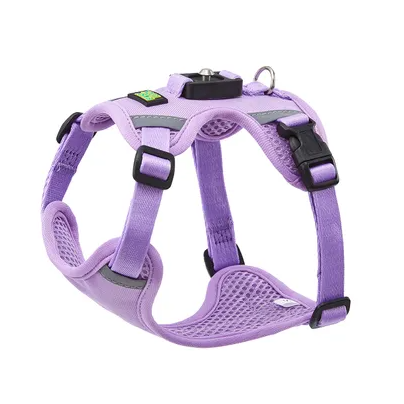
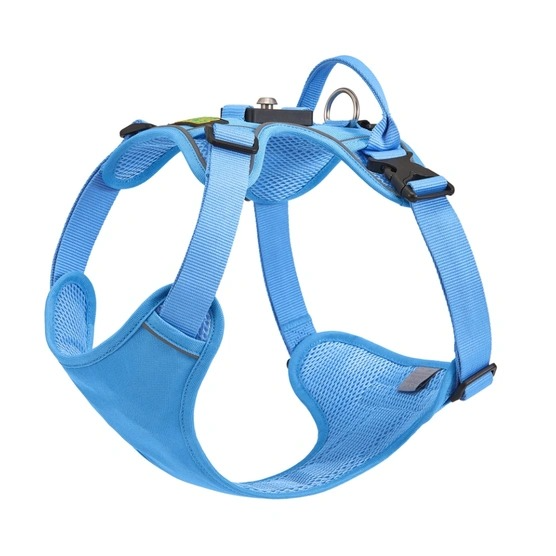
When to Switch From Collar to a Puppy Dog Harness: A Growth-Stage Guide
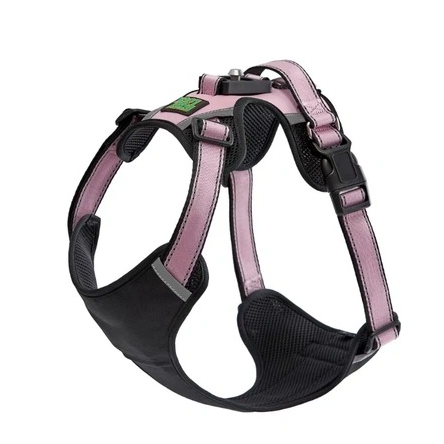
A puppy dog harness should replace the collar the moment leash training begins — typically from eight weeks of age — because a growing neck must never take leash load. Here is the growth-stage guide: when to switch, how to fit through spurts, and what the trade should stock for the segment.
Switch from collar to a puppy dog harness the moment leash training begins — typically from eight weeks of age — because a puppy's developing neck, trachea and shoulders should never absorb leash load, and a harness moves that load to the chest where a growing body can handle it. The collar keeps its job for ID tags only. This growth-stage guide explains when to switch from collar to a puppy dog harness at each development phase, how to fit a harness through growth spurts, and what the pet trade should stock for a segment where every customer is new and every fit is temporary by design.
Understanding the Necessity: Why Puppies Need Harnesses Earlier Than Owners Think
The most common timing mistake we see across our distribution partners' customer base is not switching too late in the puppy's life — it is switching too late in the walk. Many owners use a collar for the first months because it is what came home from the breeder, and the puppy seems fine. What the owner cannot see is the load path: a leash attached to a collar concentrates pulling force on the throat of an animal whose tracheal cartilage, cervical spine and shoulder structure are all still developing. Puppies also lunge without warning — everything is new and interesting — so the collar load arrives in shocks, not steady pulls.
A puppy dog harness solves this at the structural level by moving leash force to the sternum and chest, the load-bearing structures designed for it. That principle holds from the first leash introduction onward, which is why our recommendation to the trade is simple: the harness should be the default walking equipment from the first vaccination-window walks, with the collar retained for tags. The earlier the harness becomes normal, the less leash-pulling habit the puppy develops against its throat — and the easier every later stage of training becomes.
Growth Stage 1: Eight Weeks to Four Months — Introduction and Acceptance
In the first growth stage, the harness's job is acceptance, not control. The puppy is learning that wearing equipment is normal, and the design priorities follow: minimal weight, soft contact surfaces and zero fuss at fitting. A harness that takes twenty seconds of wrestling to fit teaches an eight-week-old puppy to flee the sight of it — and that learned resistance persists into adulthood. This is why we spec the puppy segment of the dog harness collection with the same priorities the adult comfort line uses: ultra-soft woven fabric with an anti-chafe finish against puppy-soft skin, and fittings that happen without pressure on the body.
The closure deserves special attention at this stage, because puppy fitting happens on a moving target. Puppies do not hold still; the owner needs gear that closes in one motion the instant the moment is right. Our fifth-generation EASYLOCK magnetic system — the magnetic quick-connect stainless steel closure covered by our patented Mag-Clip single-touch release, described on our magnetic buckle technology page — seats by proximity and one press, which turns fitting from a wrestling match into a touch. Owners in this stage consistently name it the feature that made the harness work at all.
Growth Stage 2: Four to Eight Months — The Growth-Spur Problem
The second stage is defined by growth spurts, and it is where fit discipline matters most. A puppy can change chest girth measurably within weeks; a harness fitted snugly in month four can be restrictive by month five. The rule for owners is a standing weekly check — two fingers flat under every strap, no more — and the rule for the product is adjustment range with headroom at both ends, so the fit can follow the growth rather than being replaced every month. Our adjustable buckle configurations are specified with exactly this headroom, and the adjustment sliders are engineered to hold their setting under load without creeping, because a harness that loosens itself mid-walk undoes the fit the owner just checked.
This is also the stage where pulling becomes real. Four-to-eight-month-olds are stronger, bolder and more easily overstimulated, and leash loads rise accordingly. The harness still carries that load on the chest, but the construction must now handle it: webbing width appropriate to the size class, stitching at the anchor points specified for shock loads, and a closure whose retention is mechanical rather than magnetic-force-dependent. Buyers evaluating puppy-segment products should apply the same load-path questions to puppy sizes as to adult ones — a growing dog pulls harder than its weight suggests, and the product must be dimensioned for the stage, not just the kilogram figure.
Growth Stage 3: Eight Months to Adulthood — Transition to the Adult Fit
By the final growth stage, the skeleton has largely set and the puppy dog harness graduates into its adult role. The transition decision is a sizing decision, not a product-category change: when the puppy has held its adult girth for several weeks with the harness mid-range on its adjustment, it is time to move to the adult size class — not before, because resizing early leaves the dog in an oversized harness whose fit geometry shifts with every step. The good news for owners is continuity: the habits built in stages one and two — harness normal, collar for tags, weekly two-finger check — carry straight into the adult setup, and the magnetic closure experience remains identical across sizes.
For breed-specific timing, the guidance varies by growth curve. Small breeds finish earlier — often by eight to ten months — while large and giant breeds develop for eighteen months or more and need their harness checked, and likely resized, deep into that window. Retail staff who ask one question — "how old, and which breed size?" — can route any customer to the right stage product immediately, which is why stocking the full growth curve matters: the store that fits the eight-week puppy keeps the customer through every stage that follows.
Growth-Stage Quick Reference
| Stage | Equipment Priority | Owner Habit |
|---|---|---|
| 8 weeks – 4 months | Lightweight, soft-contact, one-touch fitting | Build harness acceptance; collar = tags only |
| 4 – 8 months | Wide adjustment range, load-ready construction | Weekly two-finger fit check through spurts |
| 8 months – adult | Transition to adult size class when girth holds | Resize on stable adult girth, not before |
How to Choose a Puppy Dog Harness for the Trade
The puppy segment has a commercial property no other segment has: every single customer is a first-time buyer on a compressed replacement cycle. The puppy harness sells today, and the same customer returns for the stage-two resize, the adult size, and often the whole household that follows. This makes the segment a customer-acquisition channel disguised as a product category — and it makes product quality unusually consequential, because the brand that fits the puppy earns the family.
For buyers stocking the segment, the specification priority list runs: soft contact and low weight first (acceptance is the stage-one job), one-touch magnetic closure second (fitting happens on moving targets), adjustment headroom third (growth spurts decide return visits), and load-ready construction throughout (puppies pull harder than their weight class suggests). EASY LOCK manufactures the puppy dog harness line to exactly this list — backed by more than 15 years of webbing manufacturing, with fabric laundering fastness verified to AATCC 61 / ISO 105 methods, and closures pull-tested to 190kg+ with production stitching. Our brand was founded in 2018 and now supplies customers in 15 countries, and the puppy segment consistently rates among our partners' strongest acquisition lines.
Frequently Asked Questions
Q1: Can a puppy wear a harness at eight weeks?
Yes — with a properly sized, soft, lightweight harness, brief sessions to build acceptance, and the leash attached to the harness rather than the collar. The collar stays for ID tags. The earlier the harness becomes routine, the healthier the puppy's neck-load habits for life.
Q2: How often will we resize through puppyhood?
Typically once or twice before adulthood, driven by growth spurts. A harness with generous adjustment headroom absorbs most of the growth between sizes; the weekly two-finger check tells the owner when the straps are running out of range and the next size class is due.
Q3: Is a one-touch magnetic closure safe on a squirming puppy?
It is the safest option for exactly that scenario — the closure seats with one touch without pressing against the puppy's body, and the mechanical latch holds to the same 190kg+ pull standard as the adult range. Faster fitting also means less struggling, which is what builds harness acceptance.
Q4: What should retailers stock for the puppy segment?
The full growth curve in soft, one-touch, adjustable configurations — sized so the same customer can be fitted at every stage. For a factory-direct OEM program tailored to your market's breed mix, contact EASY LOCK with your size distribution and we will match the curve.
Final Thoughts
The switch from collar to a puppy dog harness should happen at the very start of leash life — eight weeks, first walks, harness on and collar for tags — because a growing neck should never carry leash load. From there, the growth stages write the shopping list: acceptance gear first, adjustment range through the spurt months, and the adult size once girth holds. Get the sequence right and the puppy grows up with healthy load habits; get the product right and the retailer grows a customer for the dog's whole life.
The full growth-stage puppy dog harness range — soft-contact fabrics, one-touch magnetic closures, growth-ready adjustment across every size class — is on the EASY LOCK puppy dog harness page, with the complete range in our product catalog.
Stock the Segment That Acquires Customers
Get the full puppy-to-adult growth curve as a factory-direct OEM program — soft fabrics, one-touch closures, sizing support for your market.
Build Your Puppy Program