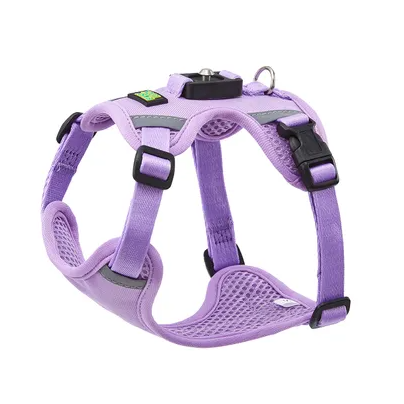
Why Webbing Width Decides Whether a Large Dog Harness Fails Under Load
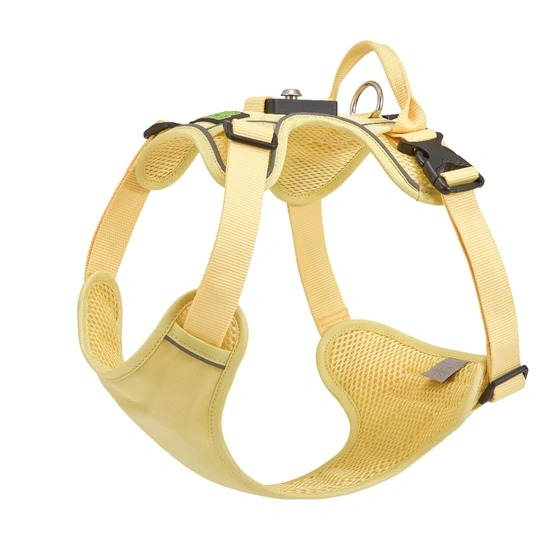
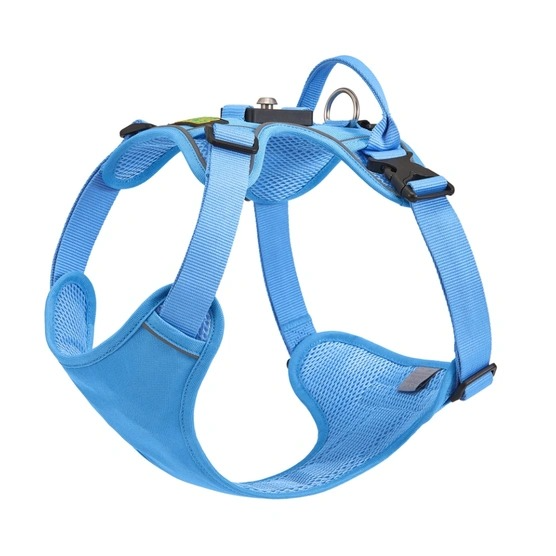
Why does one large dog harness hold through a lunge while another, equally strong on paper, fails? The variable is webbing width. From the weaving floor: how width decides survival under load, and how buyers should read width specifications before ordering.
Webbing width decides whether a large dog harness fails under load because width — not just material strength — determines how leash force spreads across the dog's chest, the harness stitching and the webbing itself. A narrow strap on a big dog concentrates load into a line; a properly wide strap turns the same force into an area. We weave our own webbing at EASY LOCK, and this article comes straight from that floor: why a large dog harness lives or dies on webbing width, how width interacts with every other component in the load path, and the width specifications B2B buyers should demand by size class.
Introduction and Industry Context
The large-dog harness market has a persistent specification gap. Size charts scale harnesses by girth measurement, which is easy to communicate, but the load consequences of a big dog do not scale with girth — they scale with the forces a large animal can generate at the end of a leash. A determined 40kg dog in a lunge transmits a shock load through the chest attachment that is several multiples of what the same force looks like statically. The harness components that absorb that load — webbing, stitching, anchors, closure — must be dimensioned for the shock, not for the label size.
Width is the most under-specified variable in that system, for a simple commercial reason: narrower webbing costs less. It uses less yarn, runs faster on the loom, and lets a product hit a weight target that looks good in marketing copy. The result is a market segment full of large dog harnesses that are dimensioned like medium harnesses with longer straps — and a return-rate pattern that follows exactly. Since we weave our own webbing, backed by more than 15 years of webbing manufacturing for global brands, width is a variable we control and specify deliberately, and it is the first thing we review when a customer's product shows edge wear, fit creep or stitching fatigue in the field.
The Technical Challenge: What Narrow Webbing Does Under Load
Break the load path into its three interfaces and the physics of width becomes concrete.
At the dog's chest, narrow webbing concentrates leash force into a contact band that is too small to spread it. Pressure per square centimeter rises, the strap digs in during a pull, and the dog's response — leaning harder, fighting the strap — increases the load further. On large, deep chests this also changes fit geometry: a narrow strap finds the path of least resistance and rides into the armpits or up toward the throat, which is the classic "strong harness, miserable dog" complaint that has nothing to do with the harness's rated strength.
At the stitching, width governs how many load-bearing stitches share the force. Stitch strength is roughly additive across the seam: a wider webbing carries a wider seam, more stitches in the box-and-cross pattern, and therefore a lower load per stitch. Narrow webbing under the same total load pushes each individual stitch closer to its limit, and stitch failure in the field almost always begins with the outermost stitch — the peel point — before propagating. More width means more redundancy before that peel point is ever reached.
At the webbing itself, width changes how shock loads are absorbed. A strap under sudden tension does not behave like a static rope; the load spikes, the weave works against itself, and the edges — where the yarn direction turns — take disproportionate stress. Wider webbing distributes that working stress across more yarns and a broader edge, which is why edge fray and yarn pull-through appear on narrow straps of nominally equivalent strength long before they appear on wide ones.
Solution and Engineering Insights: How We Specify Width
In our production, webbing width scales with size class as a deliberate specification, not a styling choice. Small and medium classes carry proportionally narrower webbing because their absolute loads allow it; the large and extra-large classes step up significantly, because that is where shock loads make narrow construction structurally dishonest. The principle we apply: width must track the dog's worst moment, not its average walk.
Width never works alone, though, and buyers should evaluate it as part of a system. The weave density and yarn specification determine how the chosen width performs — a wide but loosely woven strap gains little. Because we weave in-house, we control weave density per width, and our abrasion evaluation on high-rub zones follows ASTM D4966 (Martindale) methods, with laundering fastness on dyed webbing verified to AATCC 61 / ISO 105. Skin-contact fabric is held to OEKO-TEX Standard 100 expectations — a detail that matters more at large sizes, where the contact area against the coat is greatest.
The closure and anchors complete the system. On our large-dog configurations, the same fifth-generation EASYLOCK magnetic system that serves the full range — the magnetic quick-connect stainless steel closure pull-tested to 190kg+, covered by our patented Mag-Clip single-touch release — is paired with anchor stitching and D-ring hardware dimensioned for the size class. A wide, honest webbing system feeding into an under-dimensioned anchor would simply move the failure point, which is why we spec the whole load path together. The result is visible across the large dog harness range, and the closure technology itself is documented on our magnetic buckle technology page.
Width Red Flags When Auditing Supplier Samples
- The large size uses the same webbing width as the medium, just longer
- Chest panel webbing narrower than the girth straps it feeds into
- Seam width visibly narrower than the webbing — load-bearing stitches bunched at the edge
- No abrasion or fastness data offered for the webbing specification
- Marketing leads with total harness weight ("ultra-light") on a large-size product
Benefits and Expected Output: What Correct Width Buys You
For the end user, correct width converts directly into walk quality: the harness stays in its fitted position under load, pressure spreads over the sternum instead of digging a line, and the dog stops fighting its equipment. For the B2B buyer, the same specification converts into commercial outcomes that show up in the P&L within the first season.
Return rates fall first — fit-shift and edge-wear complaints are the two biggest return drivers in the large-size segment, and both trace to under-width construction. Replacement-part and after-sales conversations shrink with them, because the components that used to fail first are the ones the width specification protected. And shelf reputation compounds in the direction you want: large-dog owners are a vocal, community-dense customer group, and a harness that visibly holds up on a strong dog earns recommendations that no advertising budget replicates.
There is also a positioning benefit that buyers sometimes miss. A large dog harness with honest width specification naturally pairs with the structural story B2B customers respond to: EASY LOCK was founded in 2018 on more than 15 years of webbing manufacturing experience, developed its fifth-generation magnetic closure through three years and 100+ rounds of material testing, and supplies customers in 15 countries. Width integrity is not a marketing line — it is the visible proof of that manufacturing depth, which is why our distribution partners lead with it in the working-dog and large-breed segments. Related structural content for those segments is collected in our industry knowledge section.
How to Choose the Right Large Dog Harness: A Buyer's Width Audit
The audit takes ten minutes with samples on your desk. Measure the webbing widths on the large size against the medium — they should step up, not stay flat. Check that the chest panel, which takes the leash load head-on, is at least as wide as the girth straps. Turn a seam and count the load-bearing pattern: box-and-cross in heavy thread, spanning the full webbing width. Pull the assembled harness hard by hand and watch whether the sliders hold and the webbing deforms. Ask the supplier for the pull-test figure with production stitching — on our lines that is 190kg+ — and for abrasion and fastness data on the webbing itself. A supplier who answers all of it in one reply has engineered the load path; one who answers with adjectives has not.
Match the audit to your market profile: markets with working breeds and sporting dogs need the top of the width range in every large size, while urban markets with calmer large breeds can sit mid-range — but should not go below it, because the occasional lunge is what the specification exists for. For OEM programs, send us your breed mix and we will confirm the width specification per size against the loads your market actually generates; that conversation happens at the factory level, because the loom is ours.
The Load Path, End to End: Following Force Through a Large Dog Harness
It helps to trace one lunge through the whole product, because width appears at every station of the journey. The force enters at the D-ring, whose anchor stitching spans the full webbing width — more width, more stitches in the box-and-cross, lower load per stitch. It travels down the chest panel webbing, where width decides whether the strap distributes the shock across the sternum or digs a line into it. It passes through the adjustment sliders, where a wide, densely woven strap presents more contact area to the slider body and deforms less under the spike. It reaches the closure, whose stainless steel mechanical latch — pull-tested to 190kg+ on our lines — completes the path.
At every station, narrow webbing raises the local stress and wide webbing lowers it. That is why a width specification is not one number but a chain property: the harness performs at the level of its narrowest component. When we audit a competitor's large-size product in customer comparisons, we literally measure the webbing at each station, and the weakest width is usually at the chest panel — the exact station that takes the load head-on. Buyers running the same audit on samples, ours included, will find the measurement takes ten minutes and predicts field performance better than any certificate in the folder.
Frequently Asked Questions
Q1: Does wider webbing mean a heavier, less comfortable harness?
Marginally heavier, yes — grams that are trivial relative to a large dog's body weight. Comfort on a large dog comes from load spreading, which is exactly what width provides. Our wide webbing uses an ultra-soft woven finish that prevents chafing, so the width works for comfort rather than against it.
Q2: What width should a large dog harness use?
The honest answer is per-size specification tied to weave density and load path design — which is why we publish configuration details to buyers rather than a single number. The red flag is flat width across size classes; the green flag is a supplier who can explain how their width scales with the load each class generates.
Q3: My current supplier's harness passed a pull test — isn't that enough?
A pull test validates peak strength, not load distribution, wear life or fit stability under repeated shock. Narrow webbing can pass a static pull test and still fail in the field through edge wear and stitch peel. Width, weave density and stitching share the specification with the pull number.
Q4: Can you produce custom widths for an OEM large-breed line?
Yes — in-house weaving is the point. Width, weave density, edge finish and color are all configurable on our looms, and the fifth-generation magnetic closure integrates with the custom load path. Send the size curve and breed profile to start the sampling.
Final Thoughts
When a large dog harness fails under load, the failure almost never starts at the rated strength — it starts at the interfaces where narrow webbing concentrates what wide webbing would have spread. Width is cheap insurance bought at the loom, and it is the clearest single indicator of whether a supplier has engineered the product for the dog's worst moment or merely assembled it for the size chart.
Weave depth is why we can make that claim: the large dog harness range at EASY LOCK runs on in-house webbing specified per size class, feeding into a magnetic closure system pull-tested to 190kg+ and proven across customers in 15 countries. Review the configurations on the EASY LOCK large dog harness page and audit any sample against the checklist above — including ours.
Audit Our Webbing Specification Yourself
Order factory samples of the large dog harness line and put the width, stitching and closure to your own load test — documentation included.
Order Audit Samples